The people around you may understand your leadership roughly twice as accurately as you understand yourself. Not slightly better—twice as accurately. We’ve measured this across more than a million evaluations, revealing a significant gap in self-awareness in leadership: the people around you often see your strengths and weaknesses more accurately than you do.
That gap between self-perception and how others perceive our leadership may be one of the greatest obstacles to leadership development. It is also what makes improving self-awareness in leadership so difficult.
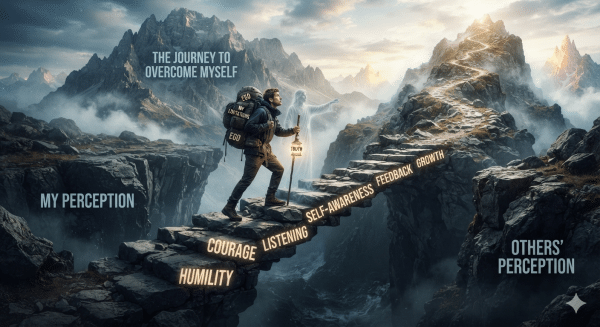
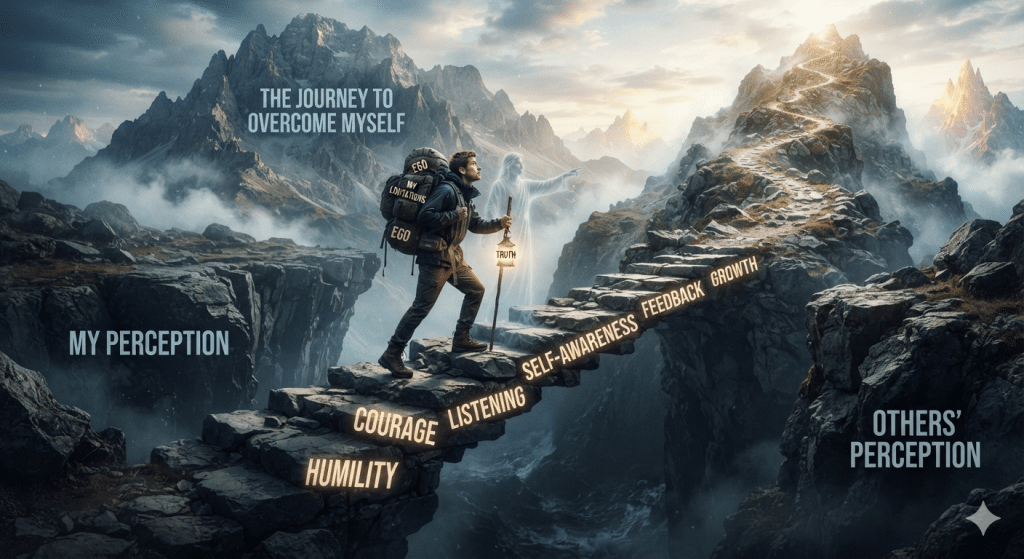
I think of it as a leader’s version of the hero’s journey.
In 1949, Joseph Campbell described a pattern he found across myths worldwide. An ordinary person is thrust into an adventure, crosses a threshold into the unknown, faces trials and ordeals, and—often with unexpected help along the way—emerges transformed. George Lucas has credited Campbell’s framework as a direct influence on the creation of Star Wars.
For the last five decades, we have watched thousands of leaders live out their own version of this journey.
Their adventure isn’t set in a mythical kingdom. It plays out in performance reviews, team meetings, difficult conversations, and everyday interactions with colleagues.
The threshold they must cross is the distance between how they perceive their own leadership effectiveness and how their manager, peers, and direct reports actually experience it.
Why Self-Awareness in Leadership Is So Difficult
The problem starts with how we’re wired.
We see and hear other people, but we can never fully see or hear ourselves the way others do.
Our intentions may be entirely honorable, but the people around us rarely have access to those intentions. They see what we do and hear what we say.
That creates an important leadership blind spot: leaders judge themselves partly by their intentions, while everyone else experiences their behavior.
We’ve measured this gap extensively.
Using a composite of self-ratings and an average of 13 rater perspectives per leader as the most accurate available benchmark, our analysis—drawn from more than 1 million evaluations from others and 130,000 self-evaluations—found that leaders’ self-perceptions were only about half as accurate as the perceptions of others.
On average, the people around a leader assess that leader’s strengths and weaknesses roughly twice as accurately as the leader assesses themselves.
That’s the real threshold every leader has to cross: not a mythical gate, but the willingness to see themselves as others see them.
How 360-Degree Feedback Improves Leadership Self-Awareness
This is one reason 360-degree feedback can be so valuable for leadership development.
A leader’s manager sees one part of their behavior. Peers see another. Direct reports experience still another. A well-designed 360-degree assessment combines these perspectives with the leader’s own assessment to create a much clearer picture of how that person’s leadership is actually experienced.
And that picture frequently differs from the one the leader has constructed for themselves.
The journey is straightforward to describe and much harder to walk:
Understand how others see you. Compare that perception with how you see yourself. Then identify a small number of specific behaviors that will make the greatest difference in your effectiveness.
It takes humility to hear the feedback and sustained effort to act on it.
But our research shows that the journey pays off.
Among leaders who take it on:
- 85% are able to meaningfully improve at least one targeted behavior, with most showing significant gains in overall effectiveness within 18 months.
- Employee engagement rises substantially, moving from the 52nd percentile before the leader’s improvement to the 67th percentile afterward.
- Turnover risk drops. The share of direct reports who said they were thinking about quitting fell from 25% to 19%.
- Discretionary effort climbs. The share of direct reports willing to go above and beyond for their leader rose from 36% to 50%.
Put simply: when leaders improve their skills and become more self-aware, engagement rises, turnover falls, and employees are more willing to give discretionary effort.
The hero’s transformation doesn’t just change the hero.
It changes the people around them.
Leadership Self-Awareness Isn’t a One-Time Achievement
Here’s where most narratives about self-improvement get it wrong: they treat transformation as a single event with a tidy ending.
Our data says otherwise.
An initial 360-degree feedback experience can produce a real and measurable shift in leadership self-awareness, but it is not a permanent fix.
Leaders who engage with feedback early and improve often get promoted—sometimes precisely because of the skills they developed.
But promotion introduces a new, harder version of the same journey.
In our research, we’ve consistently seen leaders’ effectiveness decline immediately after a promotion. That doesn’t necessarily mean they suddenly became worse leaders. Expectations at the next level are higher, and the behaviors that made them successful in their previous role may no longer be sufficient.
At the same time, honest feedback often becomes harder to obtain as leaders move higher in an organization.
Fewer people feel comfortable telling a senior executive an uncomfortable truth, even as the challenges that executive faces become more complex.
The mirror gets foggier exactly when leaders need it to become clearer.
How Leaders Can Become More Self-Aware
Leaders need an accurate, current picture of their strengths and weaknesses—and this can’t be a one-and-done exercise.
Situations change. Expectations rise. Teams change. New responsibilities expose different strengths and weaknesses.The leaders who continue succeeding are the ones who keep checking their map against the territory. But becoming more self-aware does not mean obsessing over every weakness.
One of the more counterintuitive findings from our leadership research of self-awareness in leadership is that the most effective leaders are not well-rounded, flaw-free performers.
Leaders with three profound strengths landed, on average, at the 80th percentile of overall leadership effectiveness—solidly in the top 20% of all leaders measured.
They didn’t get there by fixing everything.
They got there by identifying a handful of strengths that mattered most and building those strengths into genuine differentiators.
That reframes the entire leadership development journey.
The objective isn’t to become a flawless leader. It’s to understand accurately how others experience your leadership, identify the few strengths that can carry you the farthest, and deliberately develop them.
The Most Self-Aware Leaders Keep Asking One Question
After five decades of watching leaders take this journey, here’s what I’ve come to believe:
The real heroes aren’t the leaders who never falter.
They’re the ones willing to ask:
How am I really doing?
And then listen carefully enough to do something with the answer.
That willingness requires courage because the answer may challenge the story we’ve been telling ourselves about who we are.
But it is also where meaningful leadership development begins.
If you’re curious about your own leadership strengths, a 360-degree feedback assessment provides one of the clearest mirrors available. It allows you to compare your own perceptions with the experiences of your manager, peers, and direct reports—and identify the few strengths that could have the greatest impact on your effectiveness.
The assessment provides the mirror.
The harder—and more important—step is being willing to look.
- Joe Folkman