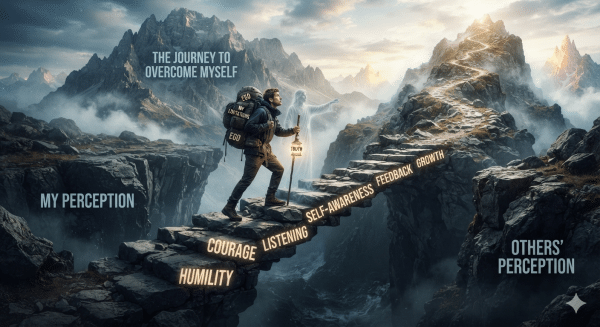
Have you ever been absolutely confident in a skill — only to receive feedback that revealed a significant gap between your self-perception and reality?
For most people, this kind of reckoning is uncomfortable. But it is also one of the most valuable experiences a professional can have.
At Zenger Folkman, we have spent decades studying what separates good leaders and high-performing contributors from truly exceptional ones. A recurring and striking theme in our research is the gap between how people see themselves and how others actually experience them — particularly in the behaviors that matter most.
“The biggest room in the world is the room for improvement.”
In 1999, two psychologists published a classic description of the phenomenon in which confidence exceeds competence. The Dunning-Kruger effect occurs when individuals with low ability, knowledge, or expertise in a particular area tend to overestimate their competence, while those with high ability often underestimate their relative skill. This arises because the same lack of knowledge that leads to poor performance also impairs one’s ability to accurately assess your own poor performance. As a result, people who know the least about a topic are often the most confident in their understanding, whereas those who are more skilled recognize the complexity of the subject and are more modest in their self-assessments.
Much has been written about this as it pertains to leaders and managers in organizations. We elected to analyze the impact of this behavior within the individual contributor population.
What Zenger Folkman’s Research Found
In a recent study, we examined a dataset of 15,730 individual contributors. Each person was rated on 18 key behaviors — identified through extensive analysis as the most influential of 50 behaviors evaluated. Crucially, each contributor rated themselves, and their direct manager rated them independently on the same behaviors.
From this dataset, we identified 609 individuals who rated themselves in the top quartile on the overall average of the 16 behaviors, while their manager rated them in the bottom quartile on the same behaviors. These are not small discrepancies — they represent a fundamental misalignment in self-perception versus observable performance.
The question we asked: which specific behaviors are most prone to this kind of overestimation?
The answer has important implications. Knowing where people commonly misjudge themselves is an early warning system — a watch-out list that can help professionals at every level calibrate more honestly and focus their development where it matters most.
The 8 Most Overrated Behaviors
The following behaviors emerged as those where the gap between self-rating and manager rating was most pronounced. For each, we offer both the underlying research insight and practical guidance for closing the gap.
Role Modeling & Influence on Others
Many people underestimate how closely their colleagues are watching them. Whether you realize it or not, your work ethic, attitude, and habits send powerful signals to everyone around you. Have you ever found yourself unconsciously matching the pace of a coworker? That is the power of modeling at work. When a colleague visibly disengages or cuts corners, it quietly signals to others that such behavior is acceptable. The reverse is equally true: people who demonstrate consistent effort and positive habits elevate the performance of everyone around them. Ask yourself regularly: What message is my behavior sending today?
Building and Sustaining Trust
Trust is the currency of professional relationships — and it is far easier to spend than to earn. It is built through consistency: saying what you will do and then doing it, every time. Even small lapses, like a missed deadline or an unkept promise, can quietly erode the confidence others place in you. Trust also grows from demonstrated expertise and, most importantly, from genuine investment in the people around you. Make it a personal standard to be someone your colleagues can count on, not occasionally, but reliably.
Anticipating and Preventing Problems
Most professionals believe they are good at spotting potential problems — yet few build the habit of proactively asking, “What could get in the way of doing this well?” It is rarely the big, obvious risks that derail quality work. More often, it is the small, overlooked details: a report that was not proofread, a file that was not labeled correctly, a message that was sent to the wrong recipient. Developing a habit of pre-flight thinking — pausing before submission to anticipate what could go wrong — separates consistently strong performers from inconsistent ones.
Follow-Through and Personal Organization
When managers were asked to rate their direct reports on this behavior, the gap between self-perception and reality was among the widest we found. Most people believe they follow through reliably; their managers often see a different picture. Commitments slip, deadlines are missed by a day, and tasks require reminders. In today’s world, there is no shortage of tools — calendars, task managers, reminders, shared project trackers — yet these are underused. A simple rule: if you make a commitment, capture it immediately. Your memory is not the system.
Drive and Work Ethic
There is a meaningful difference between doing your job and doing your job exceptionally. Most people default to a steady, acceptable pace — solid enough not to draw criticism, but rarely remarkable. The professionals who stand out are those who push themselves to go beyond what is required, delivering ahead of schedule or with higher quality than expected. Effort is visible, and it is noticed. In a competitive environment, the willingness to consistently put forward maximum effort is one of the clearest differentiators between good and truly impactful contributors.
Speaking Up and Offering Feedback
You notice a typo in a document your manager is about to present to senior leadership. You say nothing. Sound familiar? Many of us default to silence to avoid seeming presumptuous or critical — but in doing so, we miss chances to add real value. A colleague who surfaces a problem before it becomes visible to others is seen as attentive and trustworthy. In the words commonly heard today: if you see something, say something. This mindset, applied at work, builds a reputation as someone who cares about quality and outcomes, not just their own comfort.
Walking the Talk
It is remarkably easy to advocate for behaviors we do not practice ourselves. We encourage colleagues to be punctual while routinely arriving late to meetings. We stress the importance of preparation while winging our own presentations. People notice this inconsistency, even when they say nothing. Credibility is built by aligning what you say with what you do — consistently. The leader or colleague who holds themselves to the same standard they expect of others earns a rare kind of respect.
Communicating with Clarity and Impact
One of the most common and costly blind spots in our data: people who believe they communicate clearly and compellingly, but whose messages leave colleagues confused, disengaged, or unsure of what action to take. An idea that is crystal clear in your own mind can easily become muddled in delivery. Effective communicators do not rely on natural ability — they prepare. They structure their message, anticipate questions, and practice out loud. If you are not occasionally rehearsing important communications before delivering them, you are likely leaving impact on the table.
Conclusion: Honest Self-Assessment as a Competitive Advantage
The data tells a clear story: overestimating our own effectiveness is not an occasional exception — it is a predictable human pattern. And the behaviors where we overestimate ourselves most are not peripheral. They sit at the heart of professional credibility, collaboration, and impact.
That is actually good news. These are not fixed traits or innate limitations. They are behaviors — which means they are learnable, improvable, and within your control. The first step is simply having an honest look.
“Self-awareness is not just a soft skill — it is the foundation of all other professional growth.”
Four Steps to Close Your Gap
- Seek Honest Feedback Actively. Do not wait for a formal performance review. Create regular opportunities for candid input from colleagues, direct reports, and your manager. Ask specific, behavioral questions: “When I present information in meetings, is the message clear? What would make it more impactful?” The more specific your question, the more useful the answer.
- Calibrate Before You Assume. Before rating yourself highly on any of the eight behaviors above, ask: Do I have concrete, recent evidence for this assessment? What would my manager or colleagues say if asked the same question? Honest calibration is the foundation of meaningful development.
- Close the Loop on Commitments. Build a personal system — whatever works for you — that ensures no commitment slips through without a record and a reminder. The specifics matter less than the consistency. Trust, follow-through, and professionalism all live in the small moments.
- Practice the Behaviors You Preach. Before encouraging or expecting a behavior in others, examine how consistently you model it yourself. Walk the talk is simple advice, but it requires ongoing, honest self-monitoring. The higher your role, the greater the impact of the gap when it exists.
Want to help employees build greater self-awareness and effectiveness earlier in their careers? Extraordinary You™ is Zenger Folkman’s new strengths-based development experience designed specifically for individual contributors—helping employees uncover blind spots, develop strengths, and increase their impact from day one.