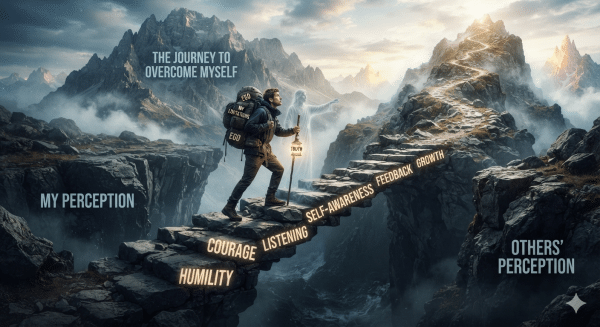
Every once in a while, a research finding causes me to stop, look twice, and wonder whether something important may be shifting—especially when it comes to leaders becoming coachable.
For years, I have worried about a troubling pattern in leadership development: leaders often become less coachable as they advance. The more senior the role, the more power, pressure, experience, and status a leader carries. Those forces can slowly narrow the leader’s learning channel. People offer less candid feedback. The leader gets busier. Success can quietly whisper, “You’ve arrived.” Earlier work with Zenger-Folkman data found that coachability tended to decline by level and age, with senior executives rated significantly lower than supervisors on coachability behaviors.
So, when looking at the most recent decade of Zenger-Folkman coachability data, I expected to see the familiar warning light flashing again. Instead, the data offered a more encouraging signal. Leaders appear to be becoming more coachable.
That is not a small finding. It is worth pausing to understand and, most importantly, to encourage.
More Than Openness
Coachability is a leader’s openness and willingness to receive feedback, learn from it, and adjust behavior or performance accordingly. In my own work, I define a coachable leader as someone who values self-improvement and operates consistently in a learning zone by applying the practices of seek, respond, reflect, and act.
That sounds simple enough until feedback actually shows up.
Most of us can recall a few feedback moments that helped us grow. We can also recall a few that felt clumsy, threatening, unfair, or even damaging. Feedback may be called a gift, but many leaders experience it more like a package wrapped in sandpaper. Receiving it well requires more than good manners. It requires enough confidence to hear the message and enough humility to learn from it.
That balance is what I call the coachable learning zone.
The Trend Is Moving in the Right Direction
Using Zenger-Folkman 360-degree assessment data, coachability was measured through feedback from managers, peers, direct reports, and others. The coachability measure assessed whether a leader made a genuine effort to improve based on feedback and actively sought opportunities to receive feedback to improve. On average, the data included approximately 6,200 leaders worldwide each year.
From 2016 to 2025, the overall coachability percentile score increased from 48 to 61. That is a meaningful upward movement. The pattern was not perfectly linear, but the direction is clear. The last five years show especially strong improvement, with coachability moving from the low 50s in 2020 to above 61 by 2025.
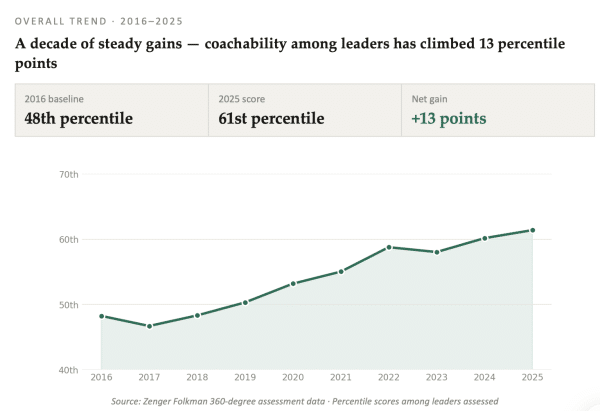
That matters because coachability is not merely a “nice-to-have” leadership trait. In prior research, low coachability was linked to blind spots and career derailment. In one analysis, derailing leaders were rated 30 percent lower on whether they sought and responded to feedback. On the positive side, other research has shown that coachability can improve, and improvements in coachability help leaders improve other leadership behaviors as well.
Gender Differences: Both Improve, but the Gap Remains
When the data is broken out by gender, both men and women show improvement over time. Male leaders increased from 45 in 2016 to 58 in 2025. Female leaders increased from 48 to 67 over the same period.
The encouraging news is that both groups are moving upward. The caution is that women were consistently rated as more coachable than men, and the gap appears to widen over time. In 2016, the female-male gap was just under four percentile points. By 2025, it had grown to more than nine points.
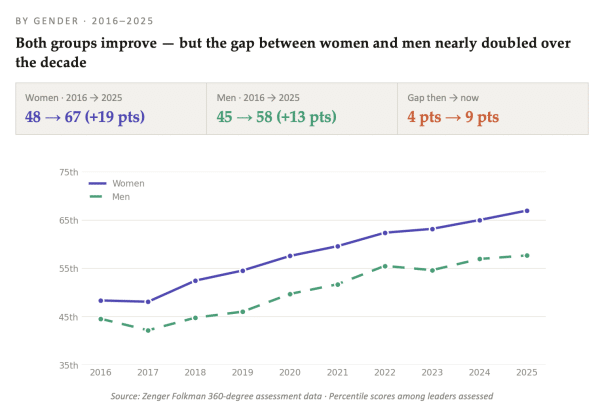
We should be careful not to over-explain this pattern without more analysis. Still, one practical implication is clear: many male leaders have an opportunity to examine whether outdated assumptions about confidence, strength, and independence are hindering coachability. Asking for input is a disciplined leadership practice for successful leaders. The best leaders do not choose between confidence and humility. They bring both.
Age Differences: The Old Pattern Is Still There, but Improving
The age data is also worth noting. Younger leaders remain the most coachable group, but all age groups improved from 2016 to 2025. Leaders aged 25 to 40 increased from 49 to 63. Leaders aged 41 to 50 increased from 45 to 62. Leaders aged 51 and older increased from 42 to 59.
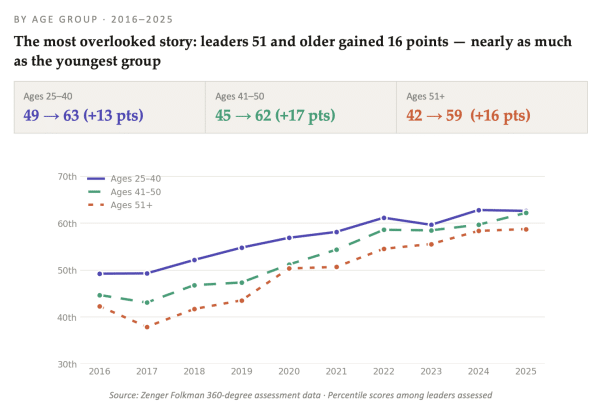
This is the most hopeful part of the data.
Yes, older leaders still score lower overall. That fits the long-standing concern that coachability can decline with age, tenure, and advancement. But the improvement among older leaders is substantial. The 51-and-up group moved more than 16 percentile points over the decade.
Coachability is not just an early-career advantage. It can be renewed. It can be practiced. It can be strengthened later in a career.
In fact, experienced leaders have the most to gain. They carry more responsibility, shape more culture, and cast a longer shadow. When senior leaders become more coachable, they do more than improve themselves. They give others permission to learn.
What Might Explain the Improvement?
The data does not explain why coachability is improving, but several factors may be contributing.
First, coaching has become more normalized. A decade or two ago, being assigned a coach could be interpreted as a warning sign. Today, coaching is more often seen as a performance accelerator. Elite athletes, executives, entrepreneurs, and high-potential leaders all use coaches. The stigma has faded.
Second, the pace of change has made the “I already know” stance harder to defend. Leaders today face shifting markets, new technologies, hybrid work, changing employee expectations, and constant disruption. In that environment, learning agility is not optional. Leaders who keep asking, listening, and adjusting are better equipped to adapt.
Third, organizations have become more familiar with 360-degree feedback and leadership development tools. Feedback may still be uncomfortable, but it is less foreign. Many leaders now expect to receive input from multiple sources. That expectation may make the act of seeking and responding to feedback feel more like normal leadership work.
Fourth, the leadership conversation has shifted. Ideas such as growth mindset, vulnerability, psychological safety, and continuous learning have become more accepted. Not all of these concepts are applied well or consistently, but it has opened the door to a healthier view of leadership: strong leaders are not finished products. They are works in progress.
Finally, the lived experience of recent years may have humbled many leaders. The pandemic, workforce disruption, social change, and AI business uncertainty forced leaders to admit they did not have all the answers. That may have nudged more leaders back into the learning zone.
Celebrate the Trend, but Don’t Declare Victory
The improvement is worth celebrating. But the data also carries a warning. Since 2020, 16 percent of leaders have remained in the bottom quartile on coachability, and 38 percent have remained below average.
That means many leaders are still missing important signals. Some are not seeking feedback. Some are not responding well when feedback arrives. Some are hearing the message but failing to reflect. Others reflect but never act.
Coachability is a chain of practices. Break one link, and the learning does not fully translate into growth. That is why the next step is not simply to admire the trend. The next step is to keep it going.
How Leaders Can Keep the Trend Moving
For individual leaders, the message is straightforward: don’t wait for feedback to find you. Seek it.
Ask a trusted colleague: “What is one thing I could do better in how I lead meetings?” Ask a direct report: “What should I keep doing, and what should I adjust?” Ask your manager: “What is one area where a small change would make me more effective?”
Then respond well. Don’t debate the message too quickly. Don’t make the other person work harder than necessary to help you. Take the note, ask a clarifying question, and say thank you.
Then reflect. Look for patterns. Ask yourself what the feedback means, where it fits, and what you may be missing.
Then act. Pick one behavior. Try one experiment. Follow up and ask whether others notice a difference.
For organizations, the message is also clear: make coachability visible, expected, and safe. Reward leaders who learn, not just leaders who look certain. Build routines where feedback is tied to improvement, not punishment. Encourage senior leaders to model coachability first. Nothing changes a culture faster than powerful people showing they are still learning.
A Good Sign Worth Strengthening
The Zenger-Folkman study is encouraging because it suggests that leaders may be warming up again to feedback, coaching, and self-improvement. That is good news for leaders, teams, and organizations.
But the work is not finished. Coachability can fade quietly.
So, let’s take this positive trend as both encouragement and invitation. Leaders are becoming more coachable. Now the challenge is to make coachability a durable habit, not a temporary improvement. Let’s keep the winning streak going.
–
Kevin D. Wilde is the author of Coachability: The Leadership Superpower, an Executive Leadership Fellow at the University of Minnesota, and a former Chief Learning Officer. Joe Folkman is the co-founder of Zenger Folkman and author of numerous best-selling leadership books.