
One of the most difficult parts of a manager’s job is giving feedback. In a survey of 7,631 people, we asked whether they believed giving negative feedback was stressful or difficult, and 44% agreed. When talking with managers about giving feedback, we often hear comments such as, “I did not sleep the night before,” “I just wanted to get it over quickly,” “My hands were sweating, and I was nervous,” and “They don’t pay me enough to do this job.” We find that because of this anxiety, some managers resist giving their direct reports any kind of critical feedback at all: when we asked a different group of 7,808 people to conduct a self-assessment, 21% admitted that they avoid giving negative feedback.
Given how unpleasant giving critical feedback can be, perhaps that isn’t surprising. But what we were surprised to see is that even more people admitted that they avoided giving positive feedback! 37% of the people who took our self-assessment conceded that they don’t give positive reinforcement.
We can only conclude that many managers feel that it’s their job to tell their direct reports bad news and correct them when they make a mistake, but that taking the time to provide positive feedback is optional.
We think this is a mistake. Our research suggests that colleagues place a great deal of emphasis on receiving positive feedback—and that it colors their relationship with one another even more than does negative feedback.
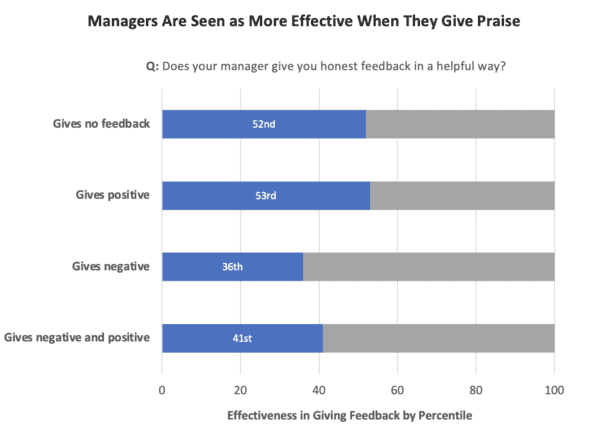
We compared 328 managers’ self-assessments with results from 360-degree feedback surveys. Each leader was rated by an average of 13 respondents on various behaviors, including “Gives honest feedback in a helpful way.” The raters who thought a person was effective in giving feedback were most influenced by the leader’s comfort and willingness to give positive reinforcement. Whether the manager gave negative feedback did not make a big difference—unless the leader avoided giving positive feedback. This was also true when we looked only at the ratings of direct reports.
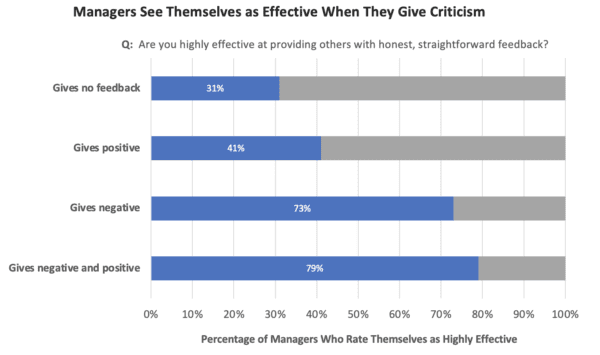
When we looked only at the managers’ self-assessments, however, we saw a different story. There was a strong correlation between people who believe they give “honest, straightforward” feedback and those who give negative feedback, regardless of whether they also give positive feedback.
Check out our latest episodes of The 90th Percentile; An Unconventional Leadership Podcast
Leaders obviously carry some incorrect beliefs about the value and benefits of different forms of feedback. They vastly underestimate the power and necessity of positive reinforcement. Conversely, they greatly overestimate the value and benefit of negative or corrective feedback. In all, they misjudge the impact negative feedback has on how they are perceived by their colleagues, bosses, and direct reports. Giving only negative feedback diminishes a leader’s effectiveness in the eyes of others and does not have the effect they believe it has.
Perhaps in an effort to provide employees with what they believe is direct, honest feedback, managers who prefer giving negative feedback may come across as only looking for what’s wrong. Some employees have described this as “Quick to criticize and slow to praise.” While our findings don’t tell us why managers are so hesitant to give positive feedback, our work with leaders suggests that there could be various reasons. Perhaps it starts with the perception that the really good managers are the tough graders who are not afraid to tell people what’s wrong. Possibly they believe that giving people positive feedback will encourage a subordinate to let up or coast. Maybe they are emulating their prior bosses who gave little praise but pointed out any mistake or weakness. Some may believe it is a sign of weakness to praise direct reports. Maybe they just don’t know how to effectively deliver appreciation or praise. Or maybe they intend to give kudos but feel so busy that the days slip by, and they never quite remember to send out that note of praise for a job well done.
Giving positive feedback is really quite simple. It’s OK if it’s brief—it just needs to be specific, rather than a general remark of “good job,” and ideally occurs soon after the praise-worthy incident. Of course, it’s also best when it’s sincere and heartfelt.
Our findings suggest that if you want to be seen as a good feedback-giver, you should proactively develop the skill of giving praise as well as criticism. Giving positive feedback shows your direct reports that you are in their corner and you want them to win and succeed. Once people know you are their advocate, it should also make giving criticism less stressful and more effective.
Connect with Zenger Folkman on LinkedIn, Twitter, and Facebook
(This article first appeared on HBR)