Why Averages Mislead
The average male life expectancy in the United States is 76.5 years; for females, it is 81.4. Median household income sits at $80,734. Your statistical likelihood of being a homicide victim is just 5.9 per 100,000 people. These numbers sound reassuring—until they aren’t.
We all know someone who died far too young. We know families for whom $80,000 a year still means choosing between rent and groceries. And inside organizations, a team’s “average” workload can look manageable—while some employees are quietly burning out. Averages compress a vast range of human experience into a single, tidy figure—and in doing so, they obscure the very stories that matter most.
The same distortion plays out every year inside organizations around the world, in the form of the annual employee engagement survey.
The Celebration Trap: When Good Averages Hide Bad News
Consider a real client we worked with several years ago. After completing their annual engagement survey, their HR team erupted in celebration: positive response rates had climbed from 53% to 62%. Leadership sent a company-wide message—”Congratulations, we achieved our goal for improvement”—and patted themselves on the back.
However, when the data was disaggregated by work group, an entirely different picture emerged. Half of the teams scored below the organizational average—five of them averaged a mere 10% positive responses. The other half scored above average, with five teams registering an astonishing 99% positive responses. The organization was not a sea of moderate engagement. It was two worlds existing side by side, one thriving and one in distress, rendered invisible by the comforting blur of an average.
“The real question the data illuminates is not ‘How are we doing on average?’ but rather: ‘What is causing our struggling teams to disengage—and what are our best teams doing right?’”
The Aggregate Problem
In an attempt to simplify analysis, reporting only overall survey results buries the real story the data tells. Organizations frequently invest enormous resources in designing, fielding, and analyzing engagement surveys—and then squander the actionable insight by stopping at the top-line number.
Two separate investigations are needed, and both are being neglected. First: What strengths are enabling high-performing work groups to generate such exceptional engagement? Second: What specific problems or barriers are preventing struggling teams from achieving the same? Aggregate reporting makes it nearly impossible to answer either question.
A Better Approach: Assess Teams, Not Organizations
Our recommendation is straightforward, though it represents a meaningful shift in philosophy: stop conducting the annual all-company engagement survey, and start assessing the effectiveness and engagement of individual teams.
We suggest a cadence of once every 24 months per team. This shift accomplishes several things at once:
It focuses attention and energy where change actually happens—at the team level. It creates accountability for individual managers and team leaders. It allows organizations to identify and replicate the practices of their most engaged teams. And it gives struggling teams a clear, targeted improvement path rather than an undifferentiated call to “do better.”
Organizations that make this transition consistently report substantially greater improvement in engagement scores over time, because they are solving real, specific problems rather than nudging an aggregate number.
The Most Significant Factor Impacting Employee Engagement
Over more than two decades of data collection, Zenger Folkman has arrived at one conclusion with uncommon certainty: the single greatest determinant of whether an employee is engaged at work is the effectiveness of their direct manager.
Not pay. Not benefits. Not office perks or flexible scheduling—though all of these matter at the margins. The immediate manager is, by a wide margin, the pivotal variable. This finding is robust across industries, geographies, organizational sizes, and hierarchical levels.
The chart below illustrates this relationship with striking clarity, drawing on 360-degree assessments from 123,927 leaders worldwide.
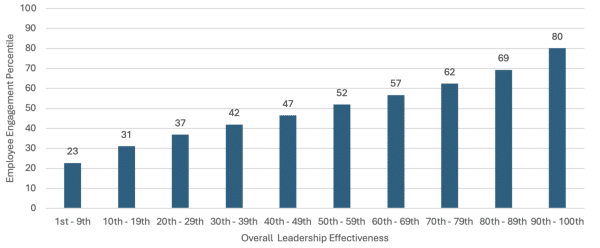
Figure 1: Employee Engagement by Overall Leadership Effectiveness Percentile. Source: Zenger Folkman database.
The pattern is unambiguous. Employees whose managers score in the bottom decile of leadership effectiveness report engagement levels of just 23rd percentile, while leaders who score in the top decile report engagement in the 80thpercentile. That 57 percentile-point gap represents an enormous difference in productivity, retention, customer satisfaction, and organizational health.
Critically, the relationship is roughly linear: each step up in leadership effectiveness corresponds to a meaningful gain in engagement. There is no threshold effect, no plateau, no point at which becoming a better leader stops paying dividends. Better leaders simply produce more engaged teams—consistently, reliably, and at scale.
Conclusion: The Path Forward
The implications of these findings converge on a single, actionable agenda for organizational leaders.
First, stop letting averages do the work of analysis. A healthy overall engagement score can coexist with pockets of profound dysfunction. The organization that celebrated a jump from 53% to 62% positive responses was not a success story—it was an organization with five deeply troubled teams, invisible to the executives who were congratulating themselves.
Second, move the unit of measurement from the organization to the team. Teams are where work gets done, where culture is actually lived, and where the quality of the manager-employee relationship plays out in real time. Assess at that level. Intervene at that level. Celebrate improvement at that level.
Third, invest relentlessly in leadership development—not as a training exercise, but as a core business strategy. The data leaves no room for ambiguity: improving a manager’s effectiveness is among the highest return investments an organization can make. Moving a leader from the 20th percentile to the 60th percentile of effectiveness is not a soft HR outcome. It is the difference between a team where only 19% of employees are willing to exert extra effort and one where 34% are willing to work harder and do more.
Employee engagement is not a mystery. It is not primarily a function of ping-pong tables, flexible Fridays, or vision statements. It is, above all else, a function of leadership quality—measured honestly, developed deliberately, and held accountable at the team level.
“The organizations that will win the talent wars of the next decade are not the ones that run the best engagement surveys. They are the ones who build the best leaders.”
At Zenger Folkman, we have spent more than two decades helping organizations do exactly that. The evidence is clear. The path forward is knowable. The only question is whether your organization is ready to look beyond the average.
-Joe Folkman